📢 The DCR (Domestic Content Requirement) Policy implementation has been extended until 31st December 2026 for the solar sector. 🌞 Claim Up to ₹78,000 Government Subsidy Before 31 March 2027 – Switch to Solar with Anany Urja.     📢 The DCR (Domestic Content Requirement) Policy implementation has been extended until 31st December 2026 for the solar sector. 🌞 Claim Up to ₹78,000 Government Subsidy Before 31 March 2027 – Switch to Solar with Anany Urja.    
Gujarat Solar Subsidy 2026 Last Date: What a 2.18 kW Rooftop System Really Costs Your Household

Gujarat now gives homes an extra rooftop solar subsidy on top of the central PM Surya Ghar subsidy. It covers small systems up to 2.18 kW, and for those homes the household pays only 10% of the government’s benchmark cost (5% for SC and ST households). That is behind the “solar for ₹10,000” headlines. Anany Urja explains what the number means and what it leaves out.

Quick facts

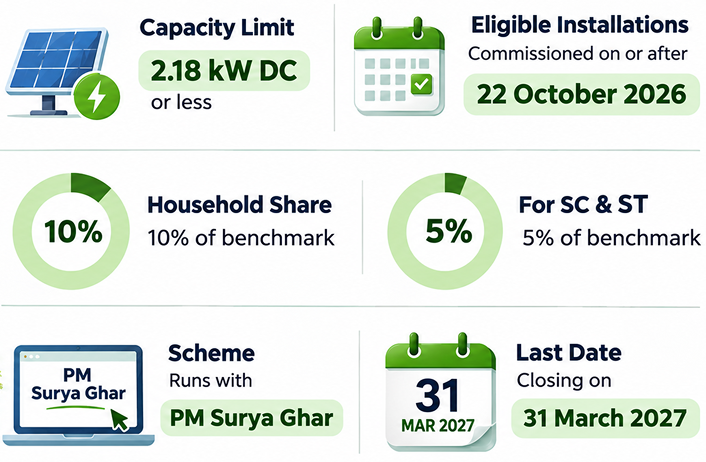
Capacity limit: 2.18 kW DC or less

Eligible installations: commissioned on or after 22 October 2026

Household share: 10% of benchmark (5% for SC and ST)

Last date: runs with PM Surya Ghar, shown on the national portal as closing 31 March 2027

Where the subsidy comes from

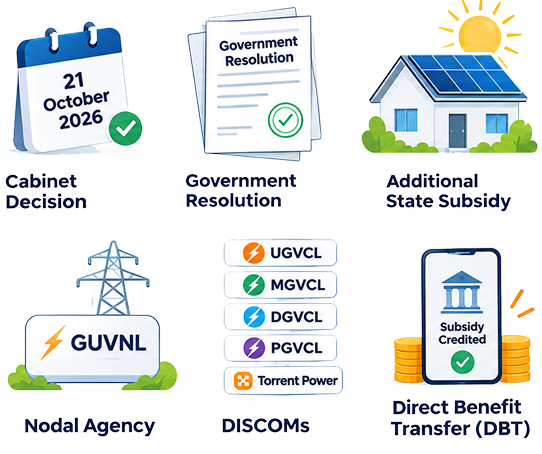
The Energy and Petrochemicals Department of the Government of Gujarat issued Government Resolution No. EPCD/BUD/e-file/20/2025/2435/B1 on 22 October 2026, after a cabinet decision a day earlier. It sets up an additional state subsidy for residential rooftop solar under PM Surya Ghar: Muft Bijli Yojana. GUVNL is the nodal agency, and the DISCOMs (UGVCL, MGVCL, DGVCL, PGVCL and Torrent Power) pay the subsidy into the consumer’s bank account through Direct Benefit Transfer.

Who qualifies

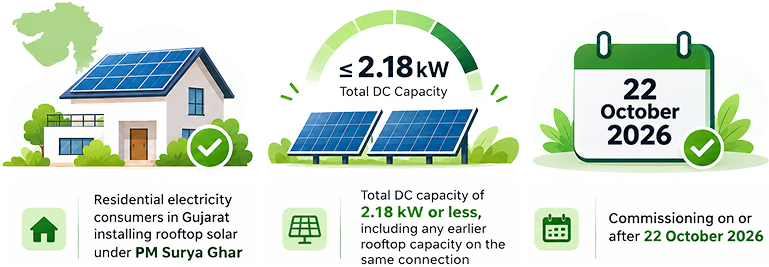
  • Residential electricity consumers in Gujarat installing rooftop solar under PM Surya Ghar
  • Total DC capacity of 2.18 kW or less, including any earlier rooftop capacity on the same connection
  • Commissioning on or after 22 October 2026

Anany Urja checks these three conditions against the electricity connection details during the first site survey, before any design work starts.

How the amount is worked out

The government uses a benchmark cost of ₹50,000 per kW for the first 2 kW and ₹45,000 per kW above that. From the benchmark, subtract the central subsidy and the household share. The state pays what remains.

System SizeCentral SubsidyHousehold PaysState SubsidyState Subsidy (SC And ST)
1 kW₹30,000₹5,000₹15,000₹17,500
2 kW₹60,000₹10,000₹30,000₹35,000

A 2 kW home therefore receives ₹90,000 in total government support. At the full 2.18 kW, the benchmark is ₹1,08,100, which puts the household share at about ₹10,810. That is the “₹10,800” figure. The DISCOM’s figure is final.

What "solar for ₹10,000" leaves out

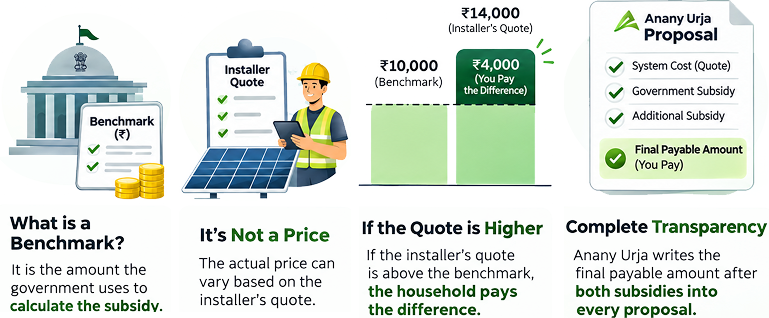
The benchmark is the number the government uses to calculate subsidy. It is not a price. If an installer’s quote is higher than the benchmark, the household pays the difference. Anany Urja writes the final payable amount after both subsidies into every proposal.

Catches to know before you sign

Above 2.18 kW the state subsidy is zero. A 3 kW system gets only the central subsidy of ₹78,000.

DC capacity is the total panel wattage. Rounded-up panel counts can push a system over the limit. Anany Urja prints the exact DC capacity on the design sheet.

The commissioning date matters. A system switched on before 22 October 2026 does not qualify, and installation should finish well before 31 March 2027 to leave room for inspection and net metering.

2.18 kW with both subsidies, or 3 kW with one

Across most of Gujarat, 1 kW generates roughly 120 to 135 units a month. A household using under about 250 units a month can cover most of its bill within 2.18 kW and collect both subsidies. At 300 units or more, a 3 kW system produces more power over 25 years, even without the state top-up. Anany Urja sizes both options from twelve months of bills and compares them in rupees.

How to apply

No separate state form has been announced so far. Applications go through pmsuryaghar.gov.in with a registered vendor, and the DISCOMs are still finalising how the state amount is paid. Anany Urja handles portal registration, the DISCOM application and net metering coordination, and confirms with the DISCOM that the application is marked for the state subsidy. SC and ST households should keep a caste certificate ready.

Frequently Asked Questions

Who can get the Gujarat state solar subsidy?

Residential consumers installing rooftop solar under PM Surya Ghar, up to 2.18 kW DC, commissioned on or after 22 October 2026.

Will I pay only ₹10,800 if I choose Anany Urja?

₹10,800 is the household share of the benchmark. If the quote is above the benchmark, you pay the difference. Anany Urja gives the final amount after both subsidies in writing.

How does Anany Urja decide between 2.18 kW and 3 kW?

Anany Urja studies twelve months of bills, the tariff slab and roof space, then compares both options in rupees.

Is there a last date for the state subsidy?

It runs with PM Surya Ghar, which the national portal shows closing on 31 March 2027.

Inquiry Now