📢 The DCR (Domestic Content Requirement) Policy implementation has been extended until 31st December 2026 for the solar sector. 🌞 Claim Up to ₹78,000 Government Subsidy Before 31 March 2027 – Switch to Solar with Anany Urja.     📢 The DCR (Domestic Content Requirement) Policy implementation has been extended until 31st December 2026 for the solar sector. 🌞 Claim Up to ₹78,000 Government Subsidy Before 31 March 2027 – Switch to Solar with Anany Urja.    

Battery Storage for Industrial Solar in India: How Factories Avoid Costly Power Downtime

For a factory, a power cut is never just a power cut. A few seconds without supply can stop machines, ruin a batch in process and cost hours of restarting. Many owners assume a solar plant already protects them from this. Most of the time it does not. Here is why, and how battery storage changes the picture for industrial solar in India. That is exactly the kind of question worth settling at the start of a project with Anany Urja.

Why Solar Alone Does Not Prevent Downtime

Most industrial solar plants are grid-tied. When the grid fails, they are designed to switch off automatically, mainly for the safety of line workers. So the moment supply drops, your panels go quiet too, even on a sunny afternoon. Solar also dips with cloud cover and stops at night. Diesel generators fill the gap, but they take time to start, burn costly fuel and cannot smooth out the voltage dips that trip sensitive equipment. This is why a feasibility study, which Anany Urja begins every project with, looks at the site and its load, not just panel capacity.

What a Battery Actually Does

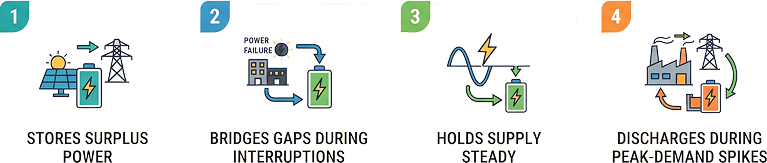
A battery closes that gap. It stores surplus solar power, or cheap grid power, and releases it when needed. During a short interruption it bridges the gap so machines keep running while the generator starts or the grid returns. During a voltage dip it helps hold supply steady. During a peak-demand spike it can discharge to ease the draw from the grid. Together these cut unplanned stoppages, restart losses and diesel use.

It Is a System, Not Just a Battery Pack

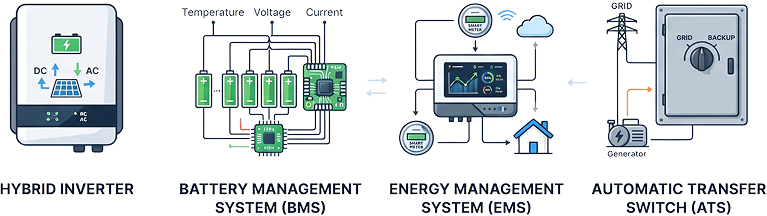
Reliable backup depends on the parts around the battery. A hybrid inverter manages the flow between solar, battery and grid. A battery management system protects cell health and lifespan. An energy management system decides when to charge and discharge, and an automatic transfer switch moves the load across without a gap.

Size It Around Critical Loads

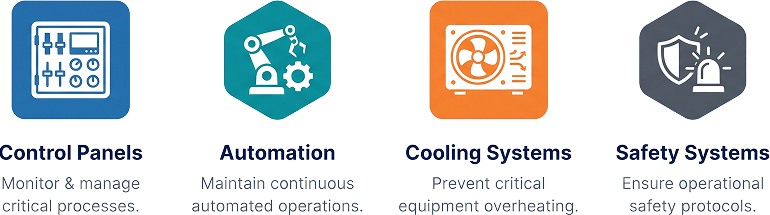
Backing up an entire factory is rarely practical or affordable. The smarter route is to list the loads that cannot stop: control panels, automation, cooling for sensitive processes, safety systems. Then size the battery for how long those loads must run. Pharmaceuticals, food processing, cold storage and precision machining often justify storage first, because even a brief outage can spoil product or scrap a run. Batteries also cost real money, so a plant with simple loads and a reliable grid may not need one yet. A site survey with the Anany Urja team is the natural place to list these loads, before any price is discussed.

How Anany Urja Supports Industrial Solar Reliability

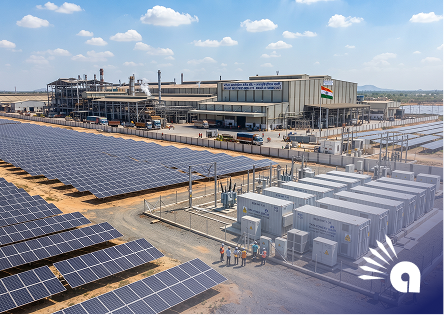
Whatever storage decision you make, the solar plant underneath has to be right first. Anany Urja, a trusted solar EPC company in Surat, Gujarat, begins with consultation, a site survey and a feasibility study, then moves to engineering and design aimed at maximum generation, long-term performance and high safety standards. As an industrial solar installation company, Anany Urja handles procurement of premium components, reliable inverter technologies, approvals, installation, testing and commissioning. Its SOLARMAN Smart remote monitoring tracks daily generation and detects faults instantly, and preventive maintenance with system health checks keeps the plant healthy. Backed by 50+ MW installed and 5,000+ customers, Anany Urja’s experience spans rooftop systems for industrial facilities, ground mount captive plants and the 5.6 MW solar park at Katkoi Tilakwada, Gujarat.

Conclusion

Solar cuts your power bill, and battery storage matched to your critical loads can protect production when the grid fails. Start by listing what cannot stop, then plan the solar plant and backup together. To plan a reliable industrial solar system, talk to the Anany Urja team, who can take your project from site survey to commissioning and support it afterwards with O&M.

Frequently Asked Questions

Does solar work during a power cut?

Usually not. Grid-tied plants switch off during an outage for safety, unless the system has battery backup and the right inverter.

How does battery storage reduce factory downtime?

It bridges short outages, steadies voltage dips and eases peak demand, so machines keep running.

Does Anany Urja serve industrial clients?

Yes. Anany Urja handles industrial rooftop systems, ground mount captive plants and utility-scale projects.

How does Anany Urja plan an industrial plant?

It begins with consultation, a site survey and a feasibility study, then moves to engineering and design.

Can Anany Urja plants be monitored remotely?

Yes. SOLARMAN Smart tracks daily generation, monitors performance and detects faults instantly.

Does Anany Urja offer O&M?

Yes. Anany Urja offers preventive maintenance, performance monitoring and system health checks.

Inquiry Now