📢 The DCR (Domestic Content Requirement) Policy implementation has been extended until 31st December 2026 for the solar sector. 🌞 Claim Up to ₹78,000 Government Subsidy Before 31 March 2027 – Switch to Solar with Anany Urja.     📢 The DCR (Domestic Content Requirement) Policy implementation has been extended until 31st December 2026 for the solar sector. 🌞 Claim Up to ₹78,000 Government Subsidy Before 31 March 2027 – Switch to Solar with Anany Urja.    
Gujarat Solar Subsidy 2026: How PM Surya Ghar Makes Rooftop Solar More Affordable

Gujarat has added a state subsidy on top of PM Surya Ghar for home rooftop solar up to 2.18 kWp. A general household now pays 10% of the benchmark cost and an SC/ST household pays 5%. The cabinet cleared it on 21 Oct 2026 and the Government Resolution followed on 22 Oct. Anany Urja has studied the resolution, and this is what it means for your home.

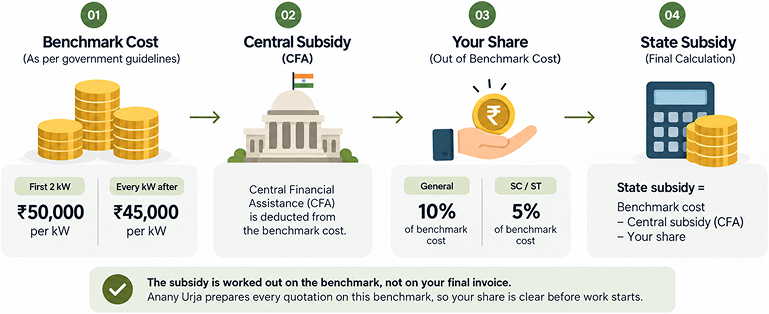
How the subsidy is calculated

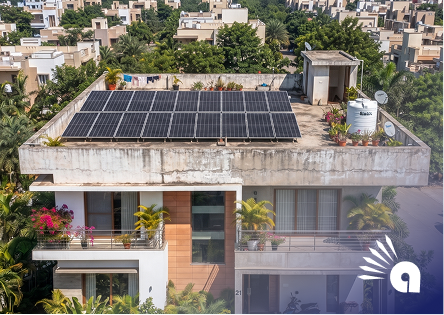
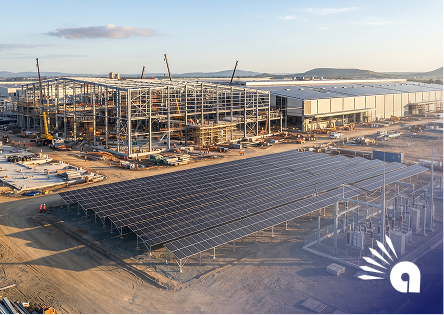
A warehouse is close to an ideal solar site. The roof is large, often flat or gently sloped and mostly free of shade from taller buildings. Large clear areas mean more panels can be laid out in a tidy, efficient pattern, which keeps installation simpler and the cost per kW manageable. Compare that with a crowded urban rooftop, where tanks, stairwells and neighbouring buildings eat into usable space.

State subsidy = Benchmark cost – Central subsidy (CFA) – Your share

Benchmark cost: ₹50,000/kW for the first 2 kW + ₹45,000/kW for every kW after

Your share: 10% (general) | 5% (SC/ST)

The subsidy is worked out on the benchmark, not on your final invoice. Anany Urja prepares every quotation on this benchmark, so your share is clear before work starts.

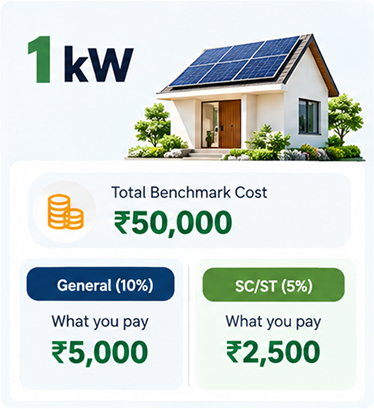
What you pay

1 kW: ₹50,000 × 10% = ₹5,000 | × 5% = ₹2,500

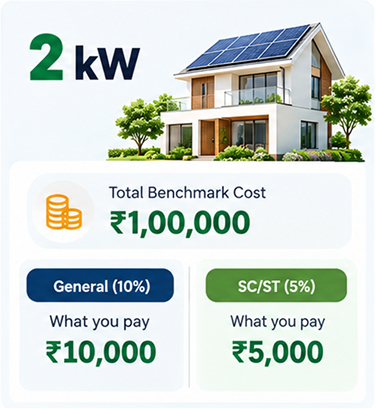
2 kW: ₹1,00,000 × 10% = ₹10,000 | × 5% = ₹5,000

2.18 kWp:
Benchmark = (₹50,000 × 2) + (0.18 × ₹45,000) = ₹1,00,000 + ₹8,100 = ₹1,08,100
Central subsidy = ₹63,240
Balance = ₹1,08,100 – ₹63,240 = ₹44,860

General (10%):
Your share = ₹10,810
State subsidy = ₹44,860 – ₹10,810 = ₹34,050
Total subsidy = ₹63,240 + ₹34,050 = ₹97,290

SC/ST (5%):
Your share = ₹5,405
State subsidy = ₹44,860 – ₹5,405 = ₹39,455
Total subsidy = ₹63,240 + ₹39,455 = ₹1,02,695
Meter, meter testing, meter box and connectivity charges (₹2,950) stay waived for residential systems up to 6 kW.

Conditions

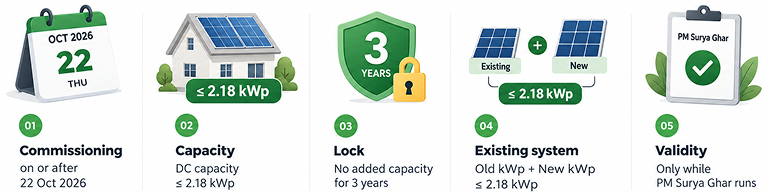
Commissioning: on or after 22 Oct 2026

Capacity: DC ≤ 2.18 kWp

Lock: no added capacity for 3 years

Existing system: old kWp + new kWp ≤ 2.18 kWp

Validity: only while PM Surya Ghar runs

Only the commissioning date counts, not the booking date. Anany Urja checks every condition against your roof, bills and any existing system before booking, and plans delivery, installation and inspection as one schedule.

Sizing around 2.18 kWp

The limit applies to DC capacity, not the inverter rating. 4 modules × 545 Wp = 2,180 Wp = 2.18 kWp. Anany Urja fixes the module count at the design stage and counts future loads like an AC or EV charger first, because capacity cannot be added later.

How the money reaches you

DISCOM (DGVCL, MGVCL, PGVCL, UGVCL or Torrent Power) → DBT → your bank account. GUVNL is the nodal agency. Anany Urja keeps the commissioning documents ready so the file does not stall.

Frequently Asked Questions

How does Anany Urja choose my system size?

Roof survey + 12 months of bills, with the DC total fixed at ≤ 2.18 kWp.

Will my Anany Urja quotation show my share?

Yes, as a rupee figure: benchmark × 10% or 5%.

Can Anany Urja add capacity to my existing system?

Yes, if old + new ≤ 2.18 kWp. The 3-year lock applies afterwards.

Who receives the subsidy, the installer or me?

You, through DBT.

Can I get the state subsidy above 2.18 kWp?

No. Anany Urja can compare a 2.18 kWp design with a larger one against your bills.

Inquiry Now