📢 The DCR (Domestic Content Requirement) Policy implementation has been extended until 31st December 2026 for the solar sector. 🌞 Claim Up to ₹78,000 Government Subsidy Before 31 March 2027 – Switch to Solar with Anany Urja.     📢 The DCR (Domestic Content Requirement) Policy implementation has been extended until 31st December 2026 for the solar sector. 🌞 Claim Up to ₹78,000 Government Subsidy Before 31 March 2027 – Switch to Solar with Anany Urja.    

Why Your Solar EPC Partner Matters More Than the Solar Panels You Choose

Why Your Solar EPC Partner Matters More Than the Solar Panels You Choose-main

Most people planning a solar installation spend weeks comparing panel brands. They read datasheets, compare efficiency ratings, and debate between mono PERC and TOPCon technology. Very few ask a more important question: who is actually going to design, install, and commission the system? That question decides more about your solar plant’s future than the panel brand ever will.

What a Solar EPC Company Actually Does

EPC stands for Engineering, Procurement, and Construction. A Solar EPC company handles the entire journey of your solar project, from the first site visit to the day the plant is switched on.

Engineering covers the technical design, from load calculations to structural planning. Procurement means sourcing the right components, not just panels but inverters, cables, mounting structures, and protection equipment. Construction is the actual installation, wiring, and commissioning.

A good Solar EPC partner doesn’t just install what you ask for. They study your site, your energy consumption pattern, and your roof or land condition, then design a system built to perform reliably for the next two to three decades.

Why the EPC Partner Has a Bigger Impact Than the Panel Brand

Two identical panels can produce very different results depending on who installs them.

Site survey and shadow analysis.

Site survey and shadow analysis.

A thorough site survey identifies shading from nearby buildings, trees, or water tanks at different times of day and across seasons. Skip this step, and even premium panels will underperform because part of the array sits in shadow during peak sun hours.

System design.

System design.

Correct string sizing, orientation, and tilt angle determine how much energy your system actually generates. A poorly designed layout can waste 10 to 15 percent of potential generation, regardless of panel quality.

Structure selection.

Mounting structures need to withstand wind loads, corrosion, and years of temperature cycling. Cheap structures rust, loosen, or shift over time, stressing panels and wiring.

Cable quality and inverter sizing.

Cable quality and inverter sizing.

Undersized cables cause voltage drop and energy loss. An incorrectly sized inverter either bottlenecks output or gets stressed beyond its rated capacity, shortening its life.

Safety standards and installation quality.

Safety standards and installation quality.

Loose connections, poor earthing, or non-compliant wiring don't just reduce efficiency, they create fire and safety risks.

Regulatory approvals.

Net metering applications, DISCOM approvals, and compliance documentation are time-consuming. A capable EPC company handles this correctly the first time, avoiding delays.

Testing and commissioning.

Testing and commissioning.

Before handover, every string, connection, and safety system needs testing. This final check is where under-qualified installers often cut corners.

What This Looks Like in Practice

Consider two factories in the same industrial area, installing similar-capacity rooftop systems with panels from the same manufacturer. One EPC company conducts a shadow analysis and designs the array around a water tank that casts shade for two hours daily. The other skips this step to save time. A year later, the first factory’s system performs close to its projected output, while the second sees a generation shortfall that takes months to diagnose, because the panels were never the problem.

In another common scenario, a business owner picks the lowest-cost installer to save on the quote. Six months in, they’re dealing with loose mounting structures, a frequently tripping inverter, and an installer who is hard to reach for support. The money saved upfront gets spent several times over in repairs and lost generation.

What to Look for Before Choosing a Solar EPC Partner

Before signing with any Solar EPC company, look beyond the quoted price per watt.

Track record: How many rooftop, commercial, industrial, or ground-mounted projects have they completed?
In-house engineering team: Do they design internally, or outsource this?
Quality standards: What component brands and practices do they follow?
After-sales and O&M support: Who monitors and maintains the system once live?
Warranty support: Will they stand behind the installation, not just the panels?
Transparency: Are they upfront about generation estimates, timelines, and costs?
Certifications: Are they empanelled with relevant authorities and DISCOMs?

These factors matter more over a 25-year lifespan than the panel brand printed on the datasheet.

How Anany Urja Approaches Solar EPC Projects

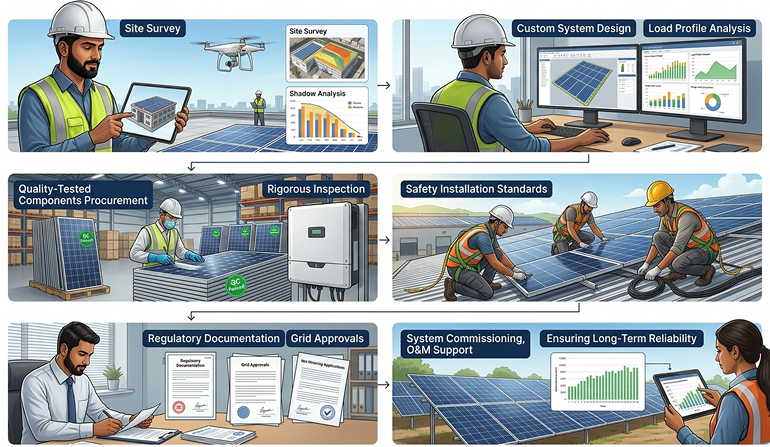
Anany Urja works across residential, commercial, industrial, and ground-mounted solar projects with an engineering-first approach. Every project starts with a proper site survey and shadow analysis, followed by a system design suited to the specific site and load profile.

The team handles procurement of quality-tested components, installation to safety standards, and complete regulatory documentation for approvals and net metering. Once commissioned, systems are backed by ongoing O&M support, so performance doesn’t drop off after the first year.

As a Solar Company in Gujarat working with business owners, MSMEs, warehouses, and institutions, the focus stays on systems that keep generating reliably, not just ones that look good on paper at handover.

How Anany Urja Approaches Solar EPC Projects

The Real Takeaway

Solar panels get most of the attention, but they’re only one part of a larger system. The engineering behind the design, the quality of procurement, and the precision of installation determine how much electricity your system generates and how long it keeps performing well.

Before finalizing your next solar project, spend as much time evaluating your EPC partner as you do comparing panel brands. It’s the decision that will shape your returns over the next 25 years.

If you’re planning a solar installation and want a team that gets the engineering right from day one, Anany Urja is happy to walk you through a proper site assessment and system design.

Frequently Asked Questions

What is a Solar EPC company?

A Solar EPC company handles the Engineering, Procurement, and Construction of a solar power system, managing everything from design and component sourcing to installation and commissioning.

Why is choosing the right Solar EPC partner important?

The EPC partner determines how well a solar system is designed, installed, and maintained, which directly affects generation output, safety, and system lifespan, regardless of panel brand.

Can poor installation reduce solar panel performance?

Yes. Issues like incorrect string sizing, shading not accounted for during design, and poor cable quality can reduce generation significantly even with high-quality panels.

Does the EPC company affect the lifespan of a solar system?

Yes. Proper structural design, quality components, and correct installation practices help a system perform reliably for 25 years, while poor execution leads to earlier degradation and frequent repairs.

How do I choose the best Solar EPC company?

Look at their completed project portfolio, in-house engineering capability, component quality standards, after-sales and O&M support, warranty terms, and transparency in communication.

Does Anany Urja provide complete EPC services?

Yes. Anany Urja handles site survey, engineering design, procurement, installation, regulatory approvals, commissioning, and ongoing O&M support for residential, commercial, industrial, and ground-mounted solar projects.

What should I ask a Solar EPC company before signing a contract?

Ask about their site survey process, design methodology, component brands, installation timeline, warranty coverage, and what O&M support is included after commissioning.

Inquiry Now