☀️ Gujarat’s Leading Solar Installers – Book Your Free Consultation Today!

How Gujarat’s Air Quality Is Silently Stealing 22% of Your Solar Profit Every Single Day

How Gujarat’s Air Quality Is Silently Stealing 22% of Your Solar Profit Every Single Day-1

Yesterday, the Anany Urja team visited a commercial complex in Gujarat to evaluate a potential solar site. At the ground level, there was a textile showroom, but its glass façade was so covered in dust and grime that you couldn’t even see what kind of fabric was displayed inside.

In that condition, how many customers would walk in? Very few.

Dust and pollution not only hide the beauty of the products; they also kill visibility and interest.

Now think about your solar panels on the rooftop.

What if one panel is so thickly coated with dust that when sunlight hits it, almost no light gets through? The panel is there, the structure is there, the investment is there-but the power? Not so much.

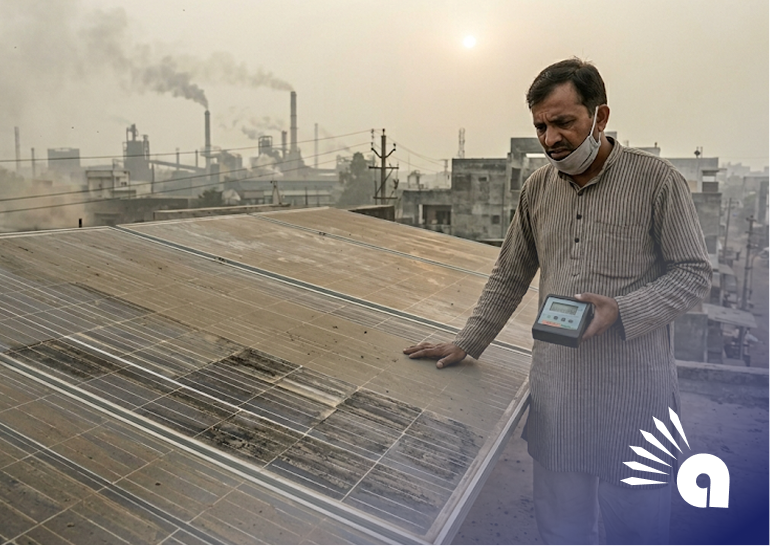
In cities like Surat and Ahmedabad, air quality is a constant challenge. Dust, soot, and construction debris hang in the atmosphere and settle on rooftops. When that dust sticks to your panels, your efficiency drops silently-day after day, week after week, year after year.

Anany Urja has done a deep‑dive audit on this issue because we know what most ordinary installers won’t tell you: there’s a hidden “dust‑tax” silently eating your solar profits-and it can be as high as 22% per day.

Let’s understand what this dust‑tax really means-and how Anany Urja’s “unique energy” approach protects your earnings.

1) Dust‑tax could be far more dangerous than you think

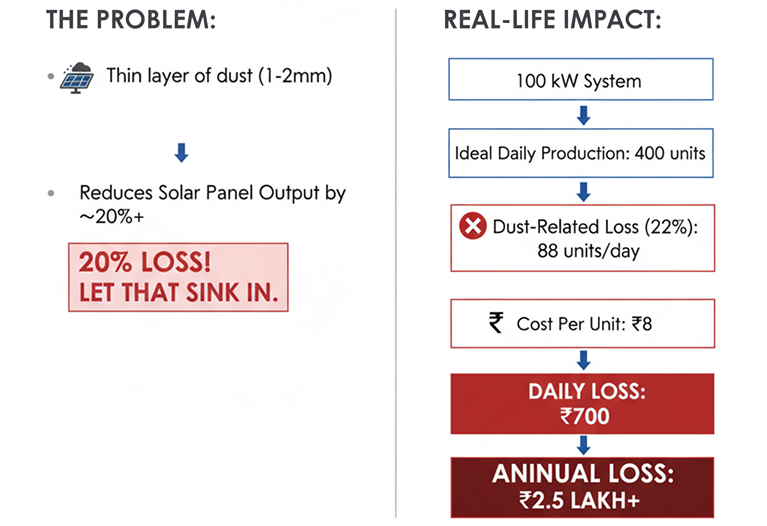
Independent studies and field analyses have shown that even a thin layer of dust-around 1-2 mm-can reduce solar panel output by about 20% or more.

Let that number sink in.

Take a simple example:

  • You have a 100 kW system that should ideally produce 400 units per day.
  • If dust‑related losses are 22%, that means 88 units are lost every single day.
  • At roughly ₹8 per unit, that’s ₹700 per day you’re throwing away-over ₹2.5 lakh per year-just because of dirt on your panels.
Dust‑tax could be far more dangerous than you think

That’s not a small “maintenance cost.”

That’s a real‑life dust‑tax you’re paying-without even realizing it.

2) Sprinkling water is not “cleaning”

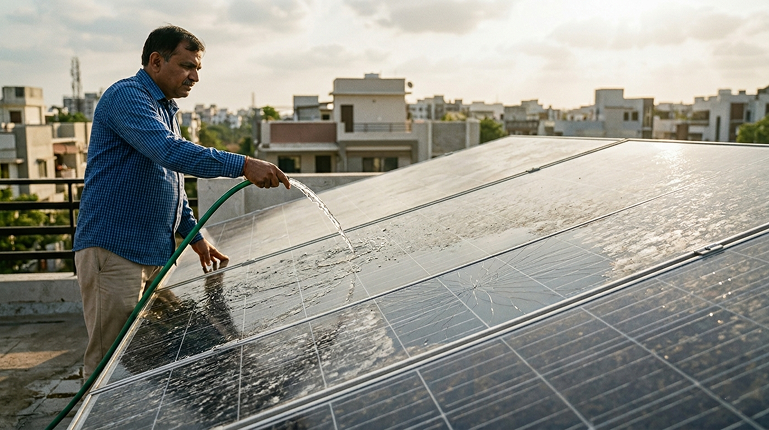
If you walk around Surat or Ahmedabad in the morning, you’ll see a common sight: people on rooftops hosing down their solar panels with plain tap water. They think they’re cleaning the panels. In reality, they’re often just wasting water and risking damage.

Here’s why:

  • If your water has high TDS or salt content, it leaves behind white, stubborn stains on the glass. These spots act like tiny mirrors, reflecting sunlight away from the cells.
  • On hot April and May afternoons in Gujarat, spraying cold water on a scorching‑hot panel can create thermal shock-sudden temperature changes that stress the glass and cells. Over time, this can lead to micro‑cracks or seal damage.
Sprinkling water is not “cleaning”

So what you see as “cleaning” can actually be:

  • A cosmetic wash that doesn’t remove abrasive dust.
  • A practice that risks long‑term panel damage.

That’s why Anany Urja doesn’t just hand over panels and say “good luck.”

We guide each customer on proper solar panel maintenance so you can enjoy 25 years of clean, reliable solar power-not just a few cheap, risky washes.

3) Natural protection against dust – built‑in, not bolt‑on

At Anany Urja, we don’t wait for dust to settle and then fight it. We design our high‑efficiency modules to resist dust from the start.

Our panels feature:

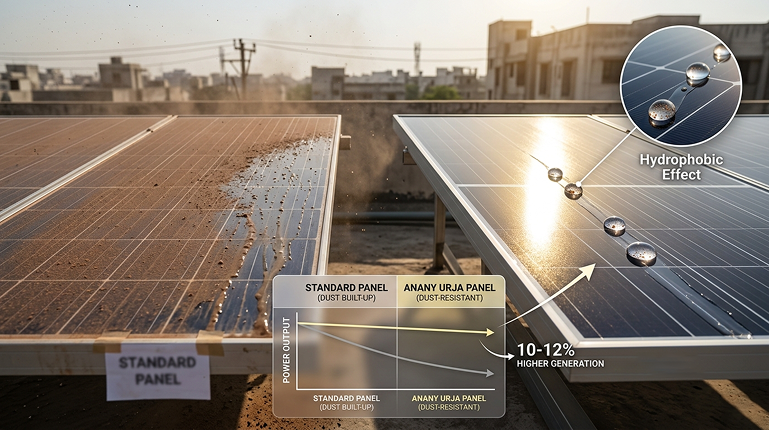
  • A special anti‑reflective coating that not only boosts light absorption but also reduces dust adhesion.
  • Hydrophobic properties that make the surface “slippery” to dirt and moisture.

In practical terms:

  • Dust finds it harder to stick in the first place.
  • When it rains, water beads up and rolls off, carrying dust with it.
  • This “self‑cleaning” effect can give you 10–12% higher generation than standard panels that get easily coated in grime.
Natural protection against dust – built‑in, not bolt‑on

In Gujarat’s dusty environment, that difference is not small.

It’s the difference between a panel that looks clean and one that actually stays clean.

4) Angle and design matter more than you think

Sometimes, the problem isn’t the panel quality-it’s the way it’s installed.

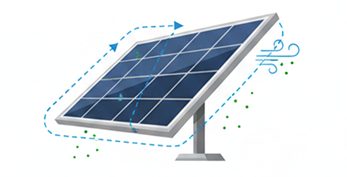
  • Water and dust accumulate in the lower corners.
  • Over time, this creates a thick band of dirt along the edges, known in the industry as “frame soiling.”
  • This band of dirt can block a significant portion of the panel’s lower cells, dragging down the whole string’s output.

Anany Urja carefully designs the structure and angle of your array to:

  • Maximize exposure to direct sunlight.
  • Allow rain and wind to naturally wash away dirt.
  • Minimize stagnation areas where dust and water can collect.
Anany Urja carefully designs the structure and angle of your array to

When you combine the right angle with our dust‑repellent coatings, you’re not just installing a solar system.

You’re building a self‑cleaning energy machine.

5) How healthy is your system really?

Sometimes, the Cleaning the surface is only half the job. At Anany Urja, we also check what’s happening underneath: isn’t the panel quality-it’s the way it’s installed.

  • Our team uses precision instruments to measure the light transmittance of your panels-how much sunlight actually passes through the glass to the cells.
  • We combine this with AI‑driven monitoring that has already been tracking every panel since manufacturing, catching even the smallest defects or underperforming strings.
  • After the inspection, you don’t just get a clean panel-you get an engineering report that explains exactly why your system is losing power and how much you’ve recovered.

We don’t just wipe the glass.

We diagnose, explain, and fix the real‑world reasons behind your losses.

Conclusion

Dust might look like a small, everyday problem. But in Gujarat’s polluted, dusty environment, it can quietly steal about 22% of your solar profits every single day. That’s not an exaggeration-it’s the math of cumulative losses.

If you want your solar investment to give you 100% of its potential for 25 years, you cannot ignore this invisible thief. The glass on your roof should be more than just decorative-it should be a pure profit‑making machine.

Anany Urja is here to make sure of that.

From dust‑resistant panels and smart design to professional cleaning and AI‑powered audits, we turn cleaning into a profit‑protection strategy.

So, do you want to keep paying that 22% dust‑tax-or do you want to stop it in its tracks?

Talk to the maintenance experts at Anany Urja today, and make your solar plant dust‑free, worry‑free, and profit‑rich. Your rooftop is already working hard. Let’s make sure it earns everything it deserves.

FAQs

If dust accumulates on a solar panel, can my electricity production really decrease by 22%?

Yes. In the dusty and polluted environment of Gujarat, even a thin layer of dust can block a significant portion of sunlight. Field studies have shown losses in the range of 15–25% depending on dust thickness and cleaning frequency.

Can I clean solar panels with plain tap water at home?

Using plain tap water may seem easy, but if your water has high TDS or salt, it can leave white, stubborn spots that reduce light transmission and can even cause long‑term damage. For best results, cleaning should be done early in the morning or late evening with filtered or low‑TDS water and using proper cleaning tools.

Will solar still work if there are clouds in the sky or it is raining?

Solar panels do not need bright, direct sunlight to work. They can still generate power from diffused light on cloudy days. In 2026, advanced technologies allow modern panels to capture a good share of daylight even in overcast or rainy conditions, though output will be lower than on clear days.

There are many cheap solar installers in the market—why should I choose Anany Urja?

Choosing the cheapest installer is often a shortcut to higher risk. Poor wiring, weak structures, and low‑quality components can lead to fires, underperformance, and expensive repairs. Anany Urja has been in the solar space since 2014 and follows Solitech DNA of quality and safety. We don’t just sell panels—we provide a power performance and safety guarantee for up to 25 years.

Be gentle with your panels, be careful with your cleaning-and let Anany Urja protect your solar profits.

Inquiry Now