📢 The DCR (Domestic Content Requirement) Policy implementation has been extended until 31st December 2026 for the solar sector. 🌞 Claim Up to ₹78,000 Government Subsidy Before 31 March 2027 – Switch to Solar with Anany Urja.     📢 The DCR (Domestic Content Requirement) Policy implementation has been extended until 31st December 2026 for the solar sector. 🌞 Claim Up to ₹78,000 Government Subsidy Before 31 March 2027 – Switch to Solar with Anany Urja.    
Ground-Mounted vs Rooftop Solar: Which One Is Better for Large Commercial & Industrial Projects?

Ground-Mounted vs Rooftop Solar Which One Is Better for Large Commercial & Industrial Projects

Every factory owner who decides to go solar hits the same fork early on. Do you cover the roof, or do you put panels on open land? Both work, and both can cut a power bill sharply. But they behave very differently once you look at space, cost, speed and long-term output. Here is how the two compare for large commercial and industrial projects.

Ground-Mounted Solar: Built for Scale

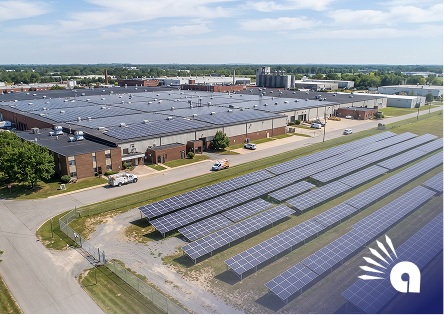
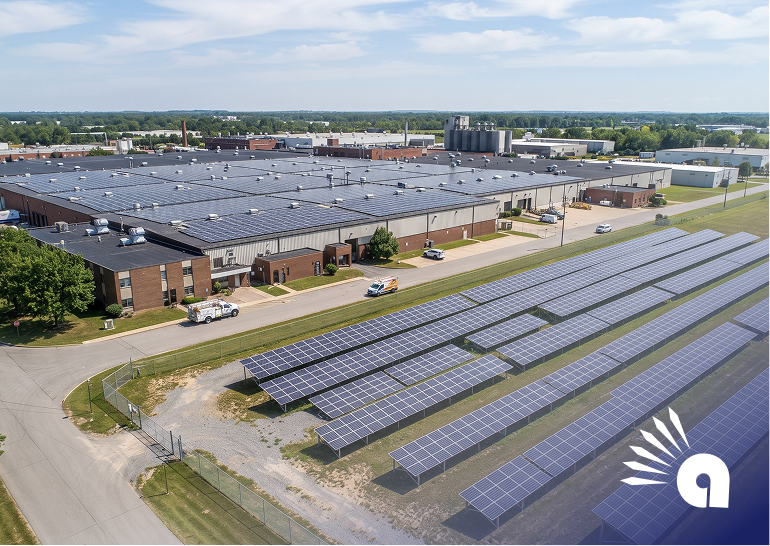
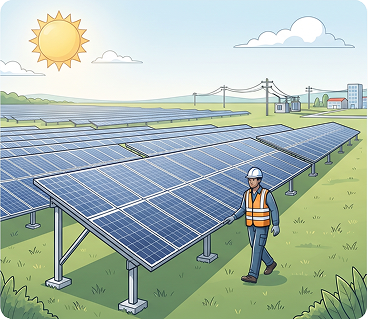
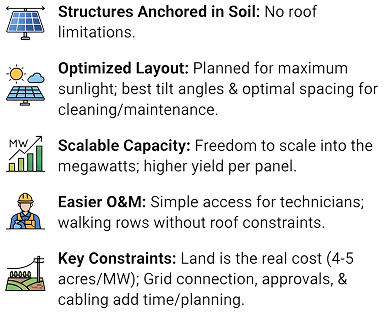
A ground-mounted system sits on structures anchored in the soil, so you are not limited by what a roof can carry. The layout can be planned around the sun rather than around the building, with panels set at the best tilt and spaced for easy cleaning and maintenance. That usually means better yield per panel and the freedom to scale into the megawatts. Operation and maintenance is also simpler, since technicians can walk the rows without worrying about roof access or load. A rough rule is four to five acres per MW, so land is the real cost and constraint. Grid connection, approvals and cable runs from plant to load also add time and planning.

Ground-Mounted Solar Built for Scale
Ground-Mounted Solar Built for Scale-2

Rooftop Solar: Using Space You Already Own

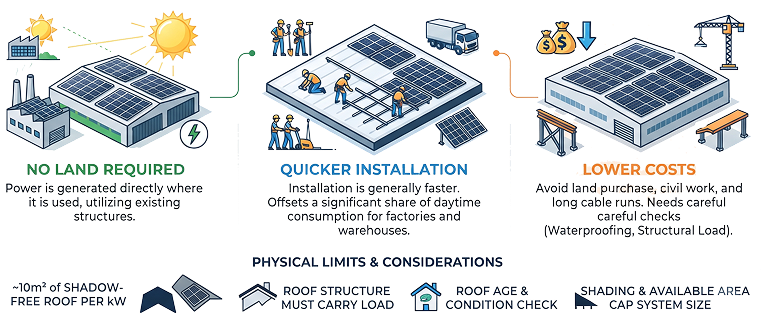
Rooftop solar goes on buildings you already have, so there is no land to buy and the power is generated right where it is used. Installation is generally quicker, and for factories with large sheds or warehouses, a rooftop can offset a big share of daytime consumption. Costs are usually lower because there is no land, civil work or long cable run to arrange, though roof waterproofing and structural checks need care. The limits are physical. You need roughly 10 square metres of shadow-free roof per kW, and the structure must safely carry the load. Roof age, shading and available area cap the system size, so a rooftop plant rarely grows beyond what the building allows.

How Anany Urja Handles Both

Anany Urja, a trusted solar EPC company in Gujarat, works on both sides of this decision. On the ground, it develops ground mount captive solar plants, DREBP solar parks and utility-scale projects, including its own 1.8 MW park at Khambhaliya Visavadar and 5.6 MW park at Katkoi Tilakwada. On rooftops, it designs customized systems for commercial buildings, industrial facilities, warehouses, hospitals and educational institutions, such as the 50 kW and 68 kW installations at Dream Liberty Wing in Mota Varachha. As a rooftop solar company in Gujarat, it handles the site survey, design, procurement, approvals, installation, commissioning, financing support and O&M as complete solar EPC solutions. Remote monitoring through SOLARMAN Smart lets owners track generation and catch faults early. As an official Waaree franchise partner and Solitech Solar distributor for Saurashtra, it also supplies N-Type TOPCon modules. For water-rich sites, floating solar is available too.

So Which One Is Better?

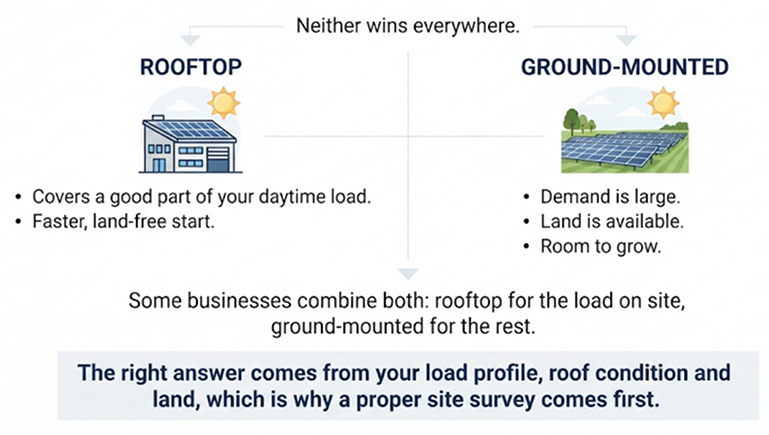
Neither wins everywhere. Pick rooftop when your roof area covers a good part of your daytime load and you want a faster, land-free start. Pick ground-mounted when your demand is large, land is available and you want room to grow. Some businesses combine both: rooftop for the load on site, ground-mounted for the rest. The right answer comes from your load profile, roof condition and land, which is why a proper site survey comes first.

Conclusion

Ground-mounted solar gives scale and design freedom, while rooftop solar gives speed and zero land cost. For Gujarat’s businesses weighing the two, Anany Urja can survey the site, size both options and manage the project from design to O&M. Get in touch with the Anany Urja team to find which fits your plant.

Frequently Asked Questions

Does Anany Urja install both ground-mounted and rooftop solar?

Yes. It handles rooftop systems for homes, businesses and industries, plus ground mount captive plants, DREBP solar parks and utility-scale projects.

Which projects has Anany Urja featured?

Solar parks of 5.6 MW at Katkoi Tilakwada and 1.8 MW at Khambhaliya Visavadar, plus 50 kW and 68 kW rooftop systems at Dream Liberty Wing.

Does Anany Urja offer floating solar?

Yes. It offers floating solar for reservoirs, lakes and industrial water bodies, using unused water surfaces.

Which solar panels does Anany Urja use?

As an official Waaree franchise partner and Solitech Solar distributor for Saurashtra, it offers N-Type TOPCon modules.

Does Anany Urja offer remote monitoring?

Yes. SOLARMAN Smart lets you track daily generation, monitor performance and detect faults instantly.

Does Anany Urja help with O&M and financing?

Yes. It provides preventive maintenance, performance monitoring and system health checks, along with financing options and subsidy guidance.

Inquiry Now