📢 The DCR (Domestic Content Requirement) Policy implementation has been extended until 31st December 2026 for the solar sector. 🌞 Claim Up to ₹78,000 Government Subsidy Before 31 March 2027 – Switch to Solar with Anany Urja.     📢 The DCR (Domestic Content Requirement) Policy implementation has been extended until 31st December 2026 for the solar sector. 🌞 Claim Up to ₹78,000 Government Subsidy Before 31 March 2027 – Switch to Solar with Anany Urja.    
What Happens to Your Solar System During Heavy Rain & Monsoon? (The Truth Most Companies Won't Tell You)

What Happens to Your Solar System During Heavy Rain -Monsoon-main

Every year, as the monsoon approaches, solar owners across Gujarat ask the same question: will heavy rain damage my panels, and will my system still generate power? Most sales-focused companies dodge a straight answer. Anany Urja Pvt. Ltd., one of Gujarat’s leading solar EPC companies, handles engineering, installation and maintenance under one roof, so monsoon performance is built into the system from day one, not an afterthought.

Here’s what actually happens during heavy rain, and what separates a system that survives monsoon season from one that struggles.

Rain Doesn't Damage Solar Panels, Poor Installation Does

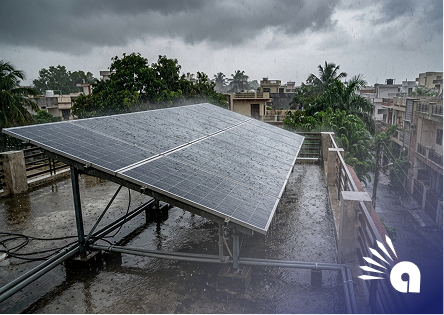
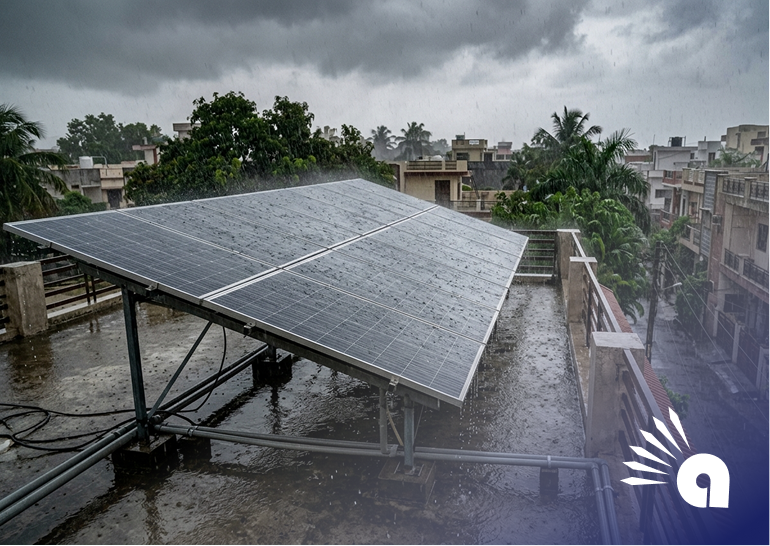
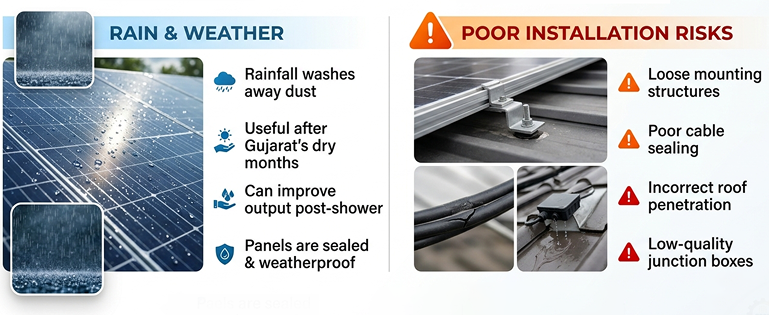
Solar panels are sealed and weatherproof, built to withstand years of sun, wind and water. Moderate rainfall is actually useful, it washes away dust that builds up during Gujarat’s dry months and can improve output right after a good shower.

The real risk is what gets overlooked during installation, not the rain itself. Loose mounting structures, poor cable sealing, incorrect roof penetration and low-quality junction boxes are what cause leaks and short circuits during storms. This is exactly why Anany Urja’s engineering standards focus heavily on installation quality, not just the modules.

Why Anany Urja's Engineering Approach Matters

Anany Urja’s Proven EPC Process includes a dedicated engineering and design stage that accounts for site-specific conditions like drainage, roof slope and structural load before installation even begins. As an official Waaree franchise partner and the official Solitech Solar distributor for the Saurashtra region, Anany Urja sources genuine, high-efficiency modules, including N-Type TOPCon technology, with proper weatherproofing and manufacturer-backed durability.

What Actually Happens During Storms

During heavy rain, a properly installed system keeps operating safely, though output dips due to cloud cover, which is normal, not a fault. What should never happen is water pooling near junction boxes or mounting structures shifting under wind load. Wind is often the bigger concern than rain itself, especially for rooftop and open-site installations. This is where the mounting structure matters as much as the panels. A ballasted mounting system, engineered to hold its ground in winds up to 180 km/h without deep roof penetration, keeps a photovoltaic system stable through exactly this kind of extreme weather, so the structure stands the test of time instead of becoming the weak link.

For ground-mounted installations, drainage planning is critical too, since standing water around inverters or cabling trenches can cause long-term corrosion if the site wasn’t graded correctly at the start.

Monitoring and Post-Monsoon Support

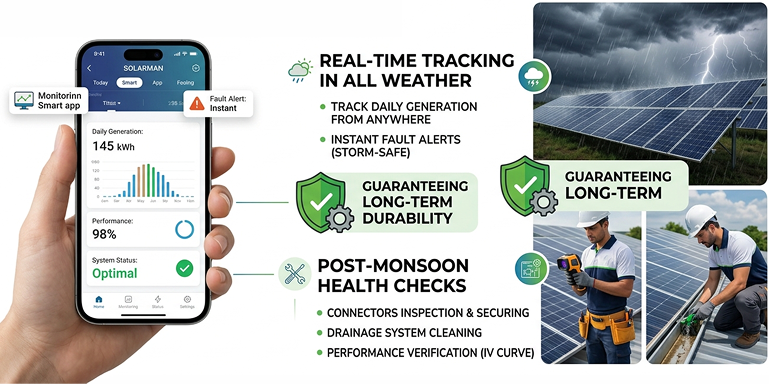
Through SOLARMAN Smart remote monitoring, Anany Urja’s clients can track daily generation and get instant fault alerts without inspecting the roof during a storm. Anany Urja’s operation & maintenance services also include post-monsoon health checks covering connectors, drainage and performance verification, the part most companies skip once the sale is made but exactly what protects a system’s long-term durability.

The Real Takeaway

Heavy rain isn’t the threat to your solar investment it’s often made out to be. A well-engineered, properly installed system will get you through monsoon season with minimal disruption. The real risk lies in cutting corners during installation and disappearing after commissioning, which is unfortunately common in the industry.

If you’re considering solar for your home or business in Gujarat, ask your installer how their systems are engineered for monsoon conditions and what support follows after the season passes. Anany Urja’s team can walk you through site-specific engineering, genuine component sourcing, and long-term maintenance support. Reach out to Anany Urja to get your site assessed before this monsoon arrives.

Frequently Asked Questions

Can heavy rain damage my solar panels?

No, properly manufactured and installed panels are weatherproof. Most monsoon-related issues trace back to poor installation, not the panels themselves.

Does Anany Urja design systems specifically for monsoon conditions?

Yes. The engineering and design stage accounts for drainage, roof slope and structural load, so systems are built to handle heavy rain and storms.

Will my solar output drop during monsoon season?

Yes, temporarily, due to reduced sunlight during cloud cover. This is expected and doesn’t indicate a system fault.

How can I monitor my system's performance during monsoon?

Through SOLARMAN Smart remote monitoring, you can track generation and get instant alerts if performance drops, without inspecting the site yourself.

Does Anany Urja provide maintenance checks after monsoon season?

Yes. The operation & maintenance service includes post-monsoon health checks covering connectors, drainage and performance verification.

What module quality does Anany Urja use to ensure durability in wet conditions?

Anany Urja is an official Waaree franchise partner and the official Solitech Solar distributor for the Saurashtra region, providing genuine, weatherproofed, high-efficiency modules including N-Type TOPCon technology.

Inquiry Now